

This piece was originally written on August 23, 2017 as my team and I took a break from our half-year retreat to climb Olumo Rock
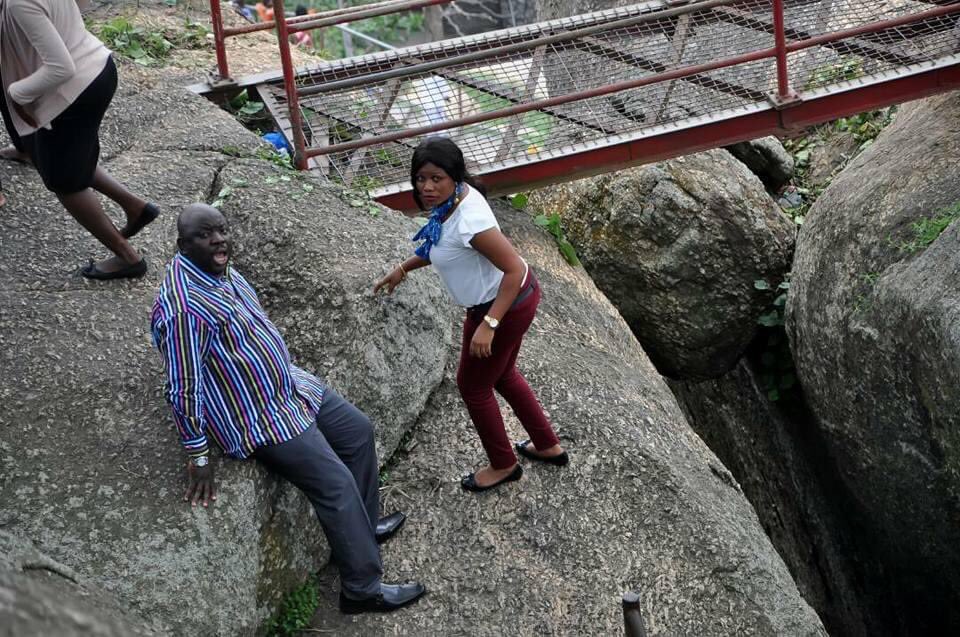
My heart was in my mouth when I climbed some portion and looked down. I saw houses looking like tiny images. I felt dizzy and said a prayer by heart. I rebuked the devil as I imagined all kinds of things.
At a point, I actually wondered aloud if I was forced to climb the rock. My hands were wet and clammy while my heart was pounding. Going back was not an option for me.
Many times, we helped one another—all the hundred of us except for a few who chose to go through the easier alternative route. At times, others who climbed and had ascended the summit encouraged others. I was one of the very last people to ascend the peak of the mountain.
Two people had to support me as I scaled what I consider the most difficult part. My whole team cheered. Though there were several man-made stairs and there is actually an alternative route, climbing the rock is not child’s play. I chose to climb because I wanted to experience the thrills firsthand rather than taking the stairs.

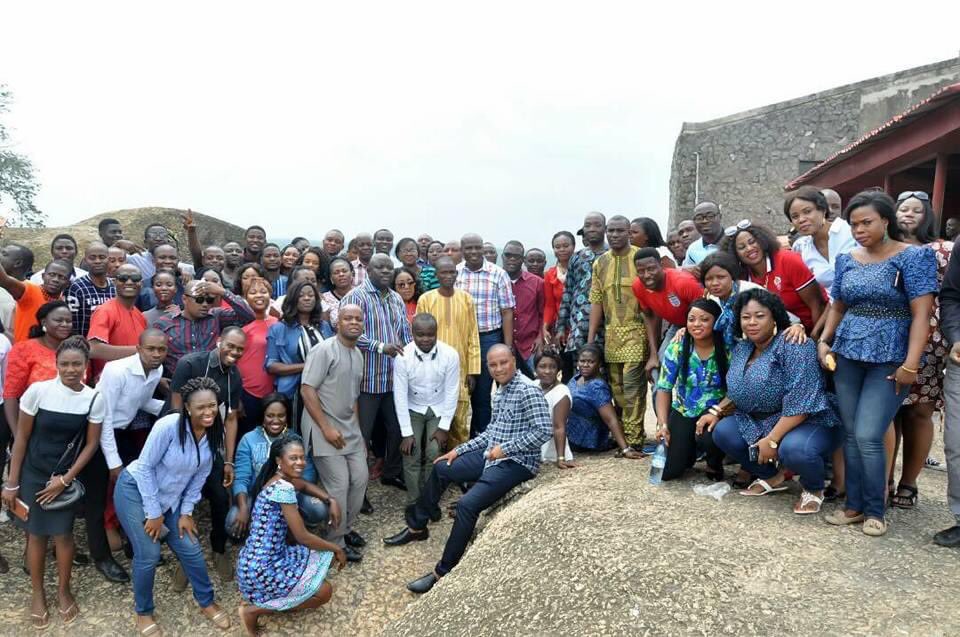
Last weekend, we had a two-day retreat session at Abeokuta. Together with about a hundred colleagues, we had a great experience reviewing the half-year performance and also taking out time to recreate.
Banking has become a very tough job in Nigeria. It has become so tough that many bankers either have high blood pressure (from crazy targets) or are diabetic (often from a sedentary lifestyle).
When bankers go on vacation, they don’t maximise the opportunity, as they have the job at the back of their minds. Nigerians don’t know how to recreate. Consequently, I try to infuse fun into any session I hold. The lifespan of work is longer than the average human lifespan.
We settled on visiting Olumo Rock and off we went last Saturday in a convoy of cars. I had been to Olumo Rock before but I didn’t climb the rock at that time. This time, I decided to maximise the opportunity and explore the tourist site.
We were divided into a group of twenty each with a tour guide assigned to each group. This is the first time in my entire life that I have met exceptional tour guides in Nigeria. These guys know their onions—from the botanical names of trees in that environment to their traditional and native names (Igbo included). They told us about the ‘Páńṣekẹ’ tree and showed us the ‘akòko’ tree, whose leaves are used in the installation of the Aláké of Egbaland.
We saw a huge baobab tree (igi Osè) that we were told has been there for about 200 years. The tour guide showed us the huge trunk and the reason for the Yoruba proverb ‘apá ò ká igi Osè’ (one’s hand can never go round the baobab tree).
There was also a ‘Dogonyaro’ tree whose leaves are quite effective in the treatment of malaria. One even gave us about 20 different interpretations of the name ‘Ogun’ in Ogun State: ‘ògùn’ (medicine), ‘ògùn’ (charm), ‘ogun’ (war), ‘Ògún’ (god of iron), ‘ógún’ (stab), ‘ogún’ (twenty), ‘òógùn’ (sweat), ‘ogún’ (property), ‘ógùn’ (it’s long), ‘ógún’ (straight) and ‘ógùn’ (climb), among others. Not that I agree with all of them, though. Some of the words are actually a combination of two words.
After 120 steps, we arrived at a place called Lisabi Gardens, named after the Egba Warrior, Lisabi. The Egba people are usually called the descendants of Lisabi—Egba Omo Lisabi. It was after the first 120 steps that the real experience began.
We arrived at a shrine where we were told sacrifices were made annually around August 5. The shrine was locked but we saw feathers and other native paraphernalia on the door. Only the Abọrẹ̀ (Chief Priest) and Aláké are entitled to enter the shrine.
We got to a spot where there was a grave where a certain Chief Sanni, who used to be the caretaker of Olumo Rock, was buried. His family house has been fenced away from the tourist site. Not far from the grave was the entrance to the base of the rock where Egba people took refuge during the war. You cannot stand straight inside what looks like a cave, as you have to bend over. I crouched as I entered the cave and wondered how people lived in the cleft of the rock for years and made their food inside the rock.
At this point, the tour guide told us the various meanings of Olúmọ. One version gave it as ‘Ibi tí Olúwa fi ìdààmú àti wàhálà mọ’ (where God brought all troubles and trials to an end). Another version interpreted it as ‘Ibi Olú mọ’ (where God moulds destinies).
Abeokuta derived its name from this rock—‘Ìlú tó wà ní abẹ́ òkúta’, meaning the town under the rock. As we moved on, we came across a very old woman reputed to be 133 years old who lives on the rock. We took a few pictures with her and gave her some tips. Her house is right beside the ‘akòko’ tree.

We also got to a point where some greenish-looking liquid dropped from a section of the rock. The guide told us people come to get the liquid to treat several ailments.
We climbed through very narrow spaces and crevices, some of which could not hold more than one person at a time. You dare not take a false step, as a misstep may affect the person behind you. When you remember there is no safety net or rope, you can’t be too careful.
It took a little over an hour to reach the top of Olumo Rock. As we reached the summit, the tour guide asked us to sing along with him the popular song:
Mayọ̀ mayọ̀ mayọ̀ ooo,
Lórí Olúmọ
Mayọ̀ mayọ̀ mayọ̀ ooo,
Lórí Olúmọ.
He ended the tour by showing us popular landmarks from the summit of Olumo Rock, which is 410 feet above sea level. We saw the first Anglican Church, the Ogun River, MKO Abiola’s family house and several others. Looking down at the whole of Abeokuta and beyond was simply bliss.

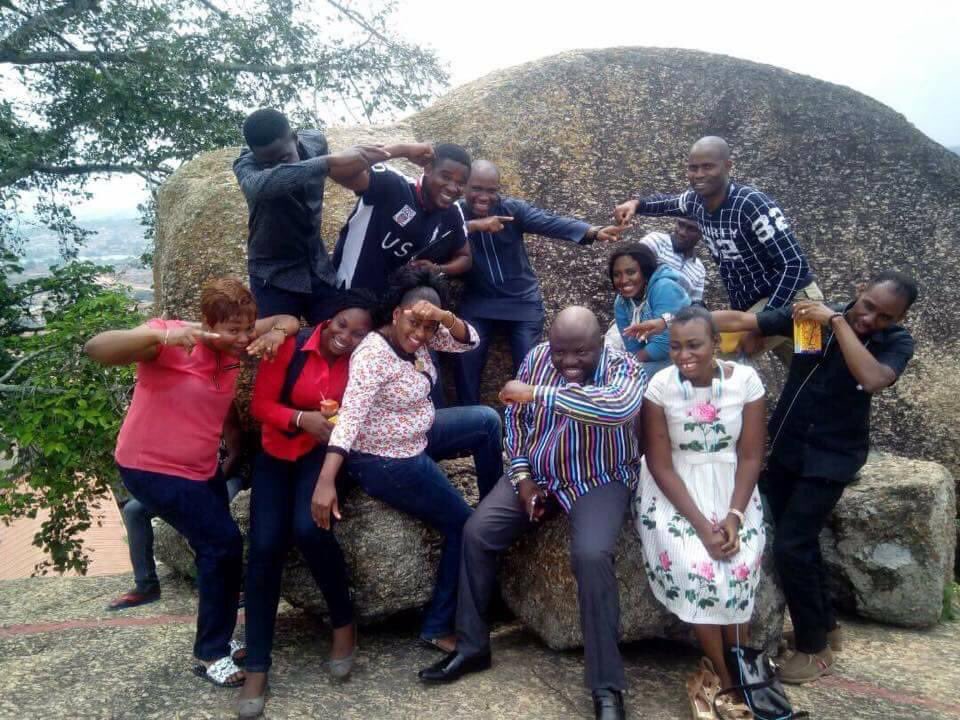
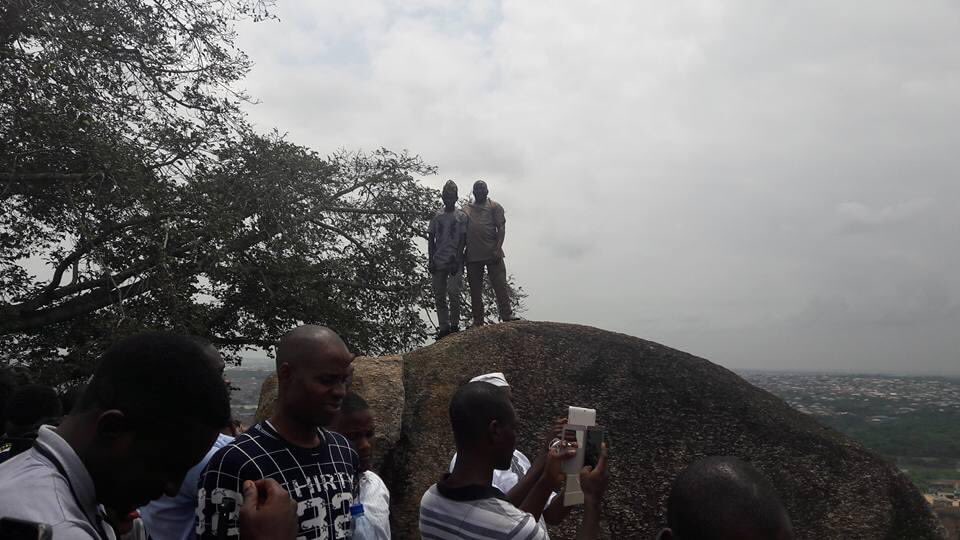
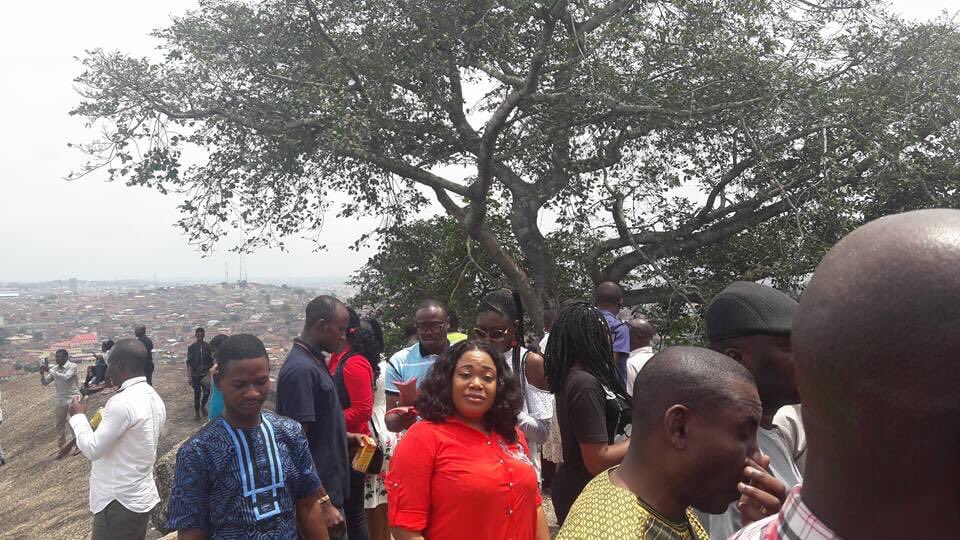
That feeling of being on the mountain top is indescribable. We went down through the alternative route—the winding stairs provided for those who were unable to summon courage to climb. By then, my whole body ached. I could hardly lift my legs as we descended Olumo Rock.
There were a few things I believe the government should consider urgently. Some portions of Olumo Rock are too dangerous not to have railings or metal guides. It’s very poor that only red lines are drawn on the rock to indicate that visitors are not to proceed beyond that point.
While the tour guide said no accident has been experienced, I believe accidents will not give advance notice. Secondly, I really don’t understand why the elevators could not be maintained. From what I learnt, it hasn’t worked this year.
Lockers or safe deposit boxes should be provided at the base of Olumo Rock for people to keep their bags and other valuables.
After the trip to Olumo Rock, my team went back to the hall we booked for our retreat. I was making a presentation when I learnt the Governor of Ogun State was around. Almost immediately, His Excellency, Governor Ibikunle Amosun, walked in with his signature cap.

The Aláké of Egbaland was with him also. We all rose to greet him and I was delighted when he took the microphone to address my team for a few minutes at my behest. It was indeed a major highlight of our retreat.



If you want to visit Olumo Rock, I suggest you go as a group so as to maximise the fun. Our group made it easier for all of us to encourage ourselves as we climbed. Also ensure you put on appropriate footwear. Avoid shoes that slip. Ladies should put on trousers. Skirts are inappropriate to climb. Ensure your clothes and especially your trousers have pockets for you to keep your phones or other valuables. Don’t carry bags along.
Will I climb Olumo Rock again? Definitely yes. But it will be through the alternative route of stairs.